Showing posts with label cognitive testing. Show all posts

Monday, August 19, 2024

A Back-to-School Checklist for Parents of Gifted and Twice-exceptional Children


Parents of gifted or twice-exceptional (2e) children are tasked with a somewhat different back-to-school checklist than other parents. Yes, the backpack, lunchbox, and basic school supplies are on the list. But parents of gifted kids bear additional challenges that come with the territory.


Here is a checklist for some of the tasks ahead:


____1. Set up that IEP meeting as soon as possible.

Once your child is settled into school, revisit their IEP, GIEP, or 504 plan (examples of terms used to denote special services for students who qualify due to a disabiity or gifted cognitive abilities). What worked last year may not work now. Make sure a meeting is in place – even to touch base about how/when/where your child will receive the support they need. Advocacy efforts, unfortunately, fall on you, since many professionals lack sufficient knowledge about giftedness or overlook gifted or twice-exceptional needs. And if you reside in an area without mandates for gfited education or your child attends a private school, set up a meeting with whomever is in charge of education support.


____2. Search for activities outside of school that support and feed your child's intense interests. 

Look for activities where they can thrive outside of the bounds of the traditional classroom, hone their skills, and where they might find true peers. Many times, these activities spark their passion and allow them to envision their future selves. Some examples include a film-making class, theatre, gymnastics, chess, or math leagues. Of course, keep within your budget. Many activities are low cost; you just have to search for them.


____3. Consider what evaluations or supports your child needs.

If your child has not received a cognitive or neuropsychological evaluation, approach your school for the next step. If gifted identification is mandated where you live, the school can provide testing. (If not, you will need to search for a private evaluation.) Supports can include any resources that help your child thrive, such as a reading specialist, occupational therapist, licensed mental health professional, or tutor. 


____4. Search for extra-curricular activities unrelated to your child's giftedness.

Sometimes stretching themselves to try something new and different (and perhaps difficult) can open your child's eyes to other possibilities. It also builds resilience. When my kids were in elementary school, for example, they were expected to pick one sport and one musical instrument. Activities unrelated to school or their giftedness broaden their horizons and offer new perspectives. Hyperfocus isn't everything!


____5. Start planning for the following year.

School may have just started, but think ahead to what your child might need going forward. Are they transitioning into middle school or high school next year? Do you need to advocate for grade or subject acceleration or more opportunities for ability grouping? Would they beneift from a different school or summer activity where their talents will flourish? Start your search early, as some programs, schools, or specialty camps fill up quickly. 


____6. If your child is in high school, start thinking about college

Learning more about college options, financial aid, and the best college fit for your child is essential.  Gather information about what will boost your child's options, such as a good score on the PSATs, classes focused on SAT prep, or dual enrollment at a college (see more about college planning here).  Identifying a college that can provide support for students with twice-exceptional conditions also may be relevant. Even if the school has a college counselor on site, you still know your child best and need to be involved with the college search.


____7. Encourage opportunities for personal and developmental growth.

Identify areas of growth that will help your child thrive. This might include a goal to work on social skills (encouraging your shy child to attend more social activities), developing improved executive functioning skills, such as planning and time management (skills that many gifted kids never develop when school is too easy), or using their gifts to help others. Incorporate family values, such as generosity and integrity, and encourage them, for example, to shovel snow for an elderly neighbor or volunteer at an animal shelter. Psychologist and author Steven Pfeiffer descibes character strengths that are essentail for enhancing emotional intelligence – something that many gifted children lack. Help them set goals that are just as important as academics.


____8. Pay attention to their social well-being.

Focus on what will support your child best with social and emotional struggles. Even the most well-adjusted, socially-connected child goes through tough times. But gifted and 2e children often have greater difficulty finding a friend who truly gets them. If your child is young, it may fall on you to set up playdates, with an eye toward encouraging time spent with peers who relate well to your child. If they are older, though, you can still offer some guidance. For example, if your child is anxious, they may require some encouragement and even goal-setting to ensure that they attend social events. If your child is highly sensitive, they may benefit from strategies that support them in stressful social situations. Sometimes, working with the school counselor, school psychologist, or a licensed mental health counselor can help.


____9. All A's are not necessarily a sign of success.

Some gifted children breeze through school, but never learn how to endure challenges or develop executive functioning skills. They assume that challenges should be easy and may avoid anything that is difficult. Underachievement can take many forms, and can be masked when your child seems to excel. Working with your child's teacher or gifted supervisor may help. They may benefit from specific tasks that require greater effort or work on developing planning and goal-setting strategies. If your child is perfectionistic, they may benefit from a grade-free option (sometimes available in elementary schools) where they work on a portfolio that showcases their progress rather than a targeted grade. 


___ 10. Pay attention to your own health and wellbeing.

Raising a gifted or 2e child is a joy, but also quite demanding. As I mentioned throughout my book about parenting gifted children, the parent's self-awareness and attention to their own needs is essential, along with developing a support network of friends, family, and parents of other gifted kids who can navigate this journey with you. When you feel strong, clear about your parenting role, and supported by others, you are better equipped to offer the support and guidance your child needs.


Wishing you well for the upcoming school year!


Related blog posts and articles


For parents:

Five tips for communicating with your gifted child's teacher

When your gifted or twice-exceptional child does not fit in: Six tips for parents

What happens when gifted kids coast through school?

Ten college planning tips: What families of gifted children need to know

Are AP classes good (or bad) for gifted students?

How parents' expectations affect their gifted child

Gifted advocacy is an education


For teachers:

First, do no harm: Nine tactics that teachers of gifted students should avoid

Three essential tips for teachers of gifted children

Intelligence denied: When gifted children's abilities are ignored

And, from psychotherapist and author, Paula Prober:

Quick back-to-school guide for teachers of gifted kids


Image: Pexels/Freestockpro


Tuesday, June 27, 2023

What happens when gifted kids coast through school?

Your super smart, inquisitive, intense gifted child had a passion for learning that was astonishing. They dove into whatever new interest consumed them and barely came up for air.

Then, school happened.

(Photo: Tony Tran/Unsplash)

How do easy A's, limited academic enrichment, and hours of boredom affect our gifted children? Some of us have seen the impact, have lived it with our children, and have struggled with this seemingly insurmountable problem. We witness our child's disengagement, their loss of interest, their minimal effort, and watch helplessly as their drive for learning seems to vanish. 


According to Jim Delisle, many gifted children are selective consumers who choose academic interests like a Sunday buffet. If they dislike the teacher or the topic, they don't bother to apply their abilities. Others are underachievers under-the-radar, a term I coined to describe gifted kids who boast reasonably good grades, keep out of trouble, and "look" successful. Teachers may assume their grades reflect effort, when in fact, these students cut corners and feel relieved about easily coasting through school without repercussions.


Of course, we know what happens to these kids. They eventually hit a wall when classwork gets harder or a boss takes them to task. By the time reality sets in, they are woefully unprepared to manage the challenge of demanding work. They often lack executive functioning skills (such as organization, time management, or study skills) and their self-confidence takes a hit when they realize that they need help or tutoring or time management support. Asking for help is anathema to them; they cannot imagine reaching out for support and feel shame about their struggles. Many retreat, drop that tough college class, or leave a job that is too challenging.


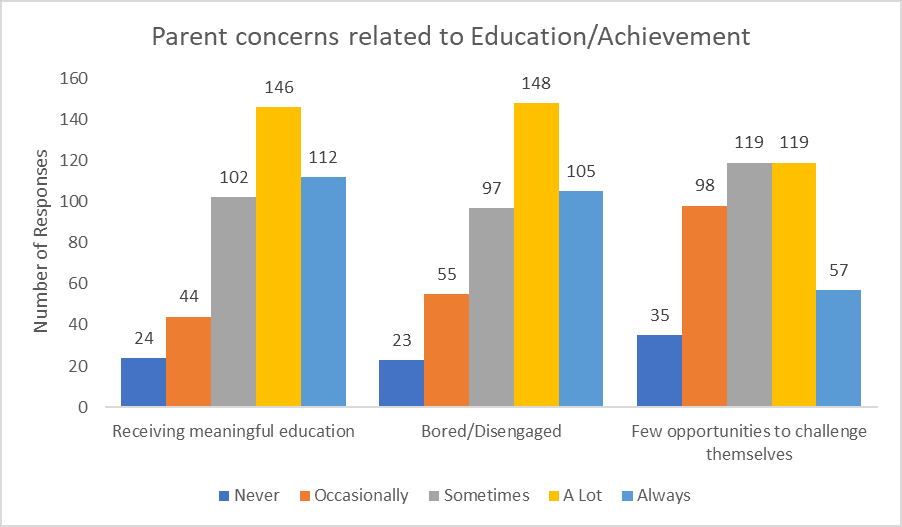
Results from an online survey of 428 parents of gifted children highlighted parents' concerns. Many worried "a lot" or "always" about whether their child would receive a meaningful education (60.2%), the impact of boredom and disengagement (59.1%), and the limited number of opportunities available where their children could challenge themselves (41.1%). (See the graph below.)


What can parents and teachers do to support these disengaged students (other than worry)? Well, the answers may seem obvious but bear repeating:

1. Ensure that a challenging academic environment is provided for all children (including gifted or twice-exceptional children) so that each child can learn in a manner consistent with their abilities. This, of course, assumes that school districts will invest in gifted programming and support teachers who require additional education about giftedness - something often lacking in their basic training. It also requires a philosophical shift where the needs of gifted children are taken seriously.


2. A range of cost-effective options, such as subject or grade acceleration, early kindergarten entry, ability grouping, or clustering gifted and highly able students together within classrooms are just a few of the options available. A recent commentary pointing to the drawbacks of lax grading policies is an example of the impact of low expectations; the author noted that students often calculated how they could expend the least amount of effort without completely failing. Of course, grades are not necessarily a good measure of a gifted student's engagement. But any policy that disincentivizes effort is sure to appeal to gifted kids who have already disengaged from the classroom.


3. Advocate for the necessity of gifted services within your school district and your State or Province. This includes arbitrary policy limitations districts impose regarding what they consider gifted education. When schools, for example, claim that gifted education does not start until third grade, or that gifted education merely involves a one-hour pull-out class, it often falls on parents to challenge these rules. 


4. Insist on universal screening, which is more likely to identify gifted students who "don't look gifted."  Those who are likely to be ignored include persons of color, students from impoverished backgrounds, rural residents, English Language Learners, or those with a competing twice-exceptional condition such as a learning disability that masks their giftedness. 


5. Insist that your child pursue educational options that will support their love of learning and push them to expend effort and challenge themselves. These might include strategies for engaging their intrinsic motivation, participation in challenging extra-curricular activities or honors and AP classes, and opportunities for building resilience and executive functioning skills.


6. Pay close attention to your child's moods; signs of disengagement or hopelessness must be taken seriously. Disinterest in previously enjoyable activities, withdrawal from friends, irritability, and changes in appetite or sleep patterns can alert you to the need for additional intervention. Enlist the school or a licensed mental health professional for support. 


The above comments offer just a few suggestions. Both parents and teachers are already juggling a lot. And when a gifted child coasts through school - and doesn't cause additional problems - the insidious effects of disengagement from learning might be overlooked. It falls on both parents and schools to take this seriously and ensure that gifted children receive the challenging education they need and deserve.


** For more insights about parenting gifted children, please see my new book, The Gifted Parenting Journey. Available through the publisher and the usual bookseller sites, this book addresses a previously neglected topic: the needs and emotional life of parents of gifted children. For more information about this book, snippets from editorial reviews, and upcoming workshops and book events, please see this link.**

Friday, April 8, 2022

Why does giftedness remain unrecognized among some gifted children?

Why are some gifted kids' talents ignored? What happens when your child doesn't "look gifted" - when they don't conform to widely held notions of giftedness and high achiever stereotypes? What contributes to the under-identification of giftedness?


There is a widespread assumption that giftedness is readily noticed and that parents and teachers easily recognize when a child is gifted. However, giftedness remains unidentified and ignored among many gifted children. 


Yes, there are some gifted kids who burst forth right out of the starting gate, displaying their precocious talents at a very young age. As they mature, their advanced abilities are so apparent that few could deny their giftedness. However, others are late bloomers, or their strengths are more visual-spatial than verbal, or their passions are skewed toward only one area of interest. Parents may doubt their perceptions when developmental milestones seem to zig-zag along a haphazard path. A child might be delayed with motor skills, for example, yet speak before their first birthday. They might be able to name every dinosaur or perform advanced math calculations, yet cannot tie their shoes.


This uncertainty about whether a child is gifted may persist for years. Parents may doubt the accuracy of their observations. They are especially likely to question their perceptions when their child is neither highly verbal nor an early reader. For example, Silverman and Golon noted that: “Children with advanced visual-spatial abilities may not be perceived as gifted by their parents or teachers unless they also demonstrate verbal precocity. When children develop speech later than their siblings, parents often worry that the children are developmentally delayed, even if they display extraordinary facility with puzzles, construction toys, creating things from odds and ends, disassembling items, and spatial memory” (p.3).


Just as some parents doubt their perceptions, overworked teachers (or those with little training in gifted education) often fail to notice gifted children who do not fit stereotypes of cooperative, high achieving, and highly verbal students. Gifted children who frequently remain unidentified may be found among students who are quiet or shy or rambunctious, who underachieve, who cannot adapt to the slow, regimented pace of traditional classrooms, or whose passions are skewed toward only one area of interest. A bored gifted child who constantly chats with other students or acts out in class may receive reprimands rather than a further investigation into what drives them. A shy gifted child may want to avoid any fanfare or attention and hide their giftedness so they can be like everyone else.


Complicating the picture even further, some gifted children display social and emotional delays where their maturity lags well behind their intellect. A five-year-old might possess the vocabulary of a teen, yet sometimes act like a toddler (often at the worst possible moments!). Asynchronous development is viewed by many as a hallmark of giftedness, and is described by the National Association for Gifted Children (NAGC) as a “mismatch between cognitive, emotional, and physical development of gifted individuals.” These varying strengths and developmental lags confuse parents and teachers alike, and confound decisions regarding school placement or options for academic acceleration. Stephanie Tolan claimed that “gifted children are on a developmental trajectory that is outside of norms from infancy onward. They reach recognized milestones of development on a schedule that is unique to them, putting them out of sync with society's expectations. In addition, they may be out of sync internally, with cognitive, social, and emotional development on separate and sometimes quite different timetables.” (p. 2). She further commented that:

“The young gifted child may appear to be many ages at once. He may be eight (his chronological age) when riding a bicycle, twelve when playing chess, fifteen when studying algebra, ten when collecting fossils, and two when asked to share his chocolate chip cookie with his sister. This variability in behavior and perception is difficult for parents and schools to handle and difficult for the child as well” (p. 2).


Gifted identification also can be clouded by a variety of developmental, learning, and social/emotional factors. Gifted abilities can be overlooked when twice-exceptional concerns (such as anxiety, learning disabilities, speech or motor delays, or signs of Attention Deficit/Hyperactivity Disorder (ADHD) or Autism Spectrum Disorder) coexist along with giftedness. The intellectual strengths of an anxious gifted child, hesitant to speak up in class, may not be noticed. A gifted child with ADHD or a hidden learning disability might utilize their intelligence to compensate for distractibility or struggles with reading or math. Yet, their gifted abilities allow them to coast through school with average grades. As a result, their ADHD may remain hidden and untreated, and their needs as a gifted learner are ignored. 


Gifted under-identification often occurs among persons of color, children raised in impoverished environments, English Language Learners, and those who are culturally different from the school’s norms (as noted here and here and here). The failure to identify giftedness in underrepresented minorities has sparked a call to action for change with how giftedness is defined and conceptualized, how gifted children are selected for enriched programming, and how gifted education is implemented (as noted here and here and here).
 The under-identification of gifted children within these populations has contributed to an “excellence gap”, where potential is neglected, enrichment is not provided, and later accomplishments never materialize. These are the children who are most in need of gifted services, yet rarely receive it. 


What can you do?


1. Educate yourself. Learn as much as possible about the intellectual and social/emotional needs of gifted children, as well as twice-exceptional concerns. Read books, articles, and research publications. Listen to podcasts, watch webinars, attend gifted education workshops, and join (or form) a gifted parents advocacy group. If your child has not yet received a cognitive evaluation, insist that testing will be provided. The more you and the school know about your child's strengths and challenges, the more you can advocate for the services they need. Parents of homeschooled children also benefit from the knowledge obtained through cognitive testing. The more you know, the more you can support your child. 


2. Make a commitment to advocate for your child. You are launched into the role of advocate - something you may not have expected, and even might resent. Yet, you know more than most about the challenges gifted children face. Advocacy does not stop with addressing academic problems at school, though. It falls on you to tactfully and persistently educate others who hold misconceptions and stereotypes about the gifted. This might include friends, extended family, neighbors, teachers, healthcare professionals, coaches, babysitters, camp counselors, and anyone else who shrugs, glares, or rolls their eyes in exasperation when your asynchronous child acts out. Approach your child's teacher as an ally and as someone who shares your goals for providing the best possible education. Gather as much information as possible, and express your concerns. And if your child is not yet identified, learn about testing and educational options that may best meet their needs. 


3. Speak up about giftedness. The "gifted" word may be fraught with controversy; it irritates those who assume the label implies that someone is "better" or more privileged. Our job involves educating others about neurodiversity, asynchronous development, and the complexities inherent in raising and educating a gifted child. Move past any possible ambivalence associated with speaking up about giftedness. Advocate for the gifted with the school administration, the school board, and state legislators (especially if gifted education is not a legally protected right in your state). Keep in mind that school policy not only affects academics but peer relationships as well.  Even more, when the school faculty become more aware that gifted abilities may remain hidden (and learn how to notice those children who have been overlooked), gifted children will have more opportunities to receive the education they need.


Some passages in this blog post are taken from an upcoming book with Gifted Unlimited Press, "The Gifted Parenting Journey: A Guide to Self-discovery and Support for Families of Gifted Children." 


This blog post is part of GHF Writer Collective's Blog Hop on "What people don't get about gifted."