Showing posts with label executive functioning. Show all posts

Thursday, July 27, 2023

The gifted child's rocky path to adulthood... and how you can help


The transition to adulthood is complicated for most of us. But gifted or twice-exceptional children bring additional challenges to the table that create some unexpected difficulties. 

Wishful thinking leads us to assume that once our gifted children mature, their lives will follow a smoother path. And for some lucky families, this certainly happens. After all, gifted children have, well... gifts in terms of exceptional cognitive abilities, intensity, focus, drive (for what interests them), and excellent critical thinking skills. They possess the foundation for a successful life ahead.

But for most parents of gifted children, the worries don't stop when their child turns 18. Our grown kids drag their childhood selves into their adult years - replete with multiple complex interests, social quandaries, existential questioning, and emotional sensitivities. All of this results in a bumpy launch into adulthood for many gifted young adults. And as parents, we watch from the sidelines, questioning what to do and when to intervene.

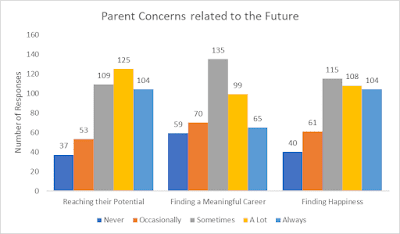
In an online survey of 428 parents of gifted children conducted in 2022 (described further in The Gifted Parenting Journey), 54% of parents claimed that they felt worried "a lot" or "always" about whether their child would reach their potential (with only 8% indicating that they "never" worried), 38% worried "a lot" or "always" that their child would not find a meaningful career (with 13% claiming that they "never" worried), and 50% worried "a lot" or "always" that their child would not find happiness as an adult (with 9% indicating that they "never" worried about this).  Clearly, most parents' worries about their gifted children extend well into the future. 

What are some of the challenges that complicate a gifted or twice-exceptional child's path to adulthood?


Heightened sensitivities and excitabilities. Increased sensitivity and intensity can create difficulty when transitioning and adapting to new circumstances. Whether adjusting to a roommate, accommodating an ever-changing daily schedule, or navigating new and complex social pressures, gifted young adults may struggle. 

The joys and stress of newfound freedom. Confronted with their longed-for independence, gifted young adults may be surprised that they might feel anxious. They may crave their independence, but now feel uncertain about making decisions on their own without relying on you to provide structure or support. 

Social pressures. Gifted kids often struggle with asynchronous development when they are young, but may continue to lag behind their peers in terms of social maturity. This becomes a challenge when confronted with very adult decisions and multiple social expectations. They must learn to listen to their inner voice when faced with pressure related to drugs, alcohol, sexual encounters, or demands from roommates or friends. Introverted gifted young adults may have difficulty finding alone time to decompress when living in crowded conditions. Many also harbor insecurities stemming from a childhood where they did not fit in with peers. 

Increased academic or career demands. Gifted kids frequently have an easy time with academic demands in high school. Most classes are easy, or at the very least, require only minimal effort. The stakes increase once they leave for college. Coursework might be challenging for the first time, which may be a shock for some. With fewer safety nets, increased demands, and steeper competition, the potential for failure looms large. And challenging career responsibilities leave little margin for error. 

Executive functioning difficulties. Many gifted children coast through school with little need to develop the planning, time management, or organizational skills so vital to success. Now they must juggle a demanding schedule that differs from day to day without parents nearby to nudge them to complete their assignments or remember a meeting time. College and career provide a rude awakening to the importance of time management, remembering deadlines, and planning ahead.

Career choices take on added urgency. No longer free to dabble in what interests them, gifted young adults must decide on a career path that will be fulfilling, meaningful, and will pay the bills. Multipotentiality (possessing a range of abilities and interests) complicates their daily lives, as well as career planning. They struggle with decisions about career choices and grieve the loss associated with relinquishing endless possibilities and the luxury of engaging in multiple passions and interests.  

Heightened existential and identity concerns. In addition to the stress of career planning, gifted young adults grapple with their sense of identity. This is similar to the existential awakenings that arose during middle school but creates an even greater sense of urgency. As noted in "What kind of gifted person will you become?" gifted folks have enormous potential, but also grapple with finding a path that is meaningful to them.

         Who am I if I compromise and make choices that contradict my values? 

Am I really smart if I fail a class or don't get hired for what seems like an ideal job?  
What happens if I choose a career path that disappoints others or leads to my own disappointment? 

What about my sexual or gender identity, my political and spiritual values, and my uncertainty about how much to assert myself?  

How do I use my abilities for the better good and find a path that is fulfilling?
How do I navigate all of the complexities of the world around me, fight climate change and injustice, and still earn a salary that allows me to be independent?

 A tall order for all young adults. But all-too-common tendencies toward overthinking, existential angst, and perfectionism create even greater challenges for the gifted.


How can parents support their adult children as they transition to adulthood? Here is a short list of simple strategies:


1. Let them know you are always there to listen. 

2. Offer advice only when they are open to it. (This is a tough one for loving, concerned parents!) Your sage wisdom will be abruptly dismissed if your timing is off or if they feel pressured or diminished.

3. Remind them that you have faith in them and trust that they will arrive at the best possible solution available.

4. Reassure them that you do not expect perfection - you just want them to thrive, put in effort when required, and find the path that suits their needs.

5. Point out that it is normal to question goals and expectations - no big decision comes easily, and their self-reflection is a sign of maturity and conscientiousness.

6. Let them know that you expect them to struggle at times - this comes with adulthood and something you have been through yourself.

7. Just like when they were young, learn to pick your battles. But battle less often. Determine when intervening is essential to their well-being (e.g., they are at risk of losing their health insurance because they forget to submit payments) or merely based on your personal preferences (e.g., they got yet another tattoo). 

7. If they are struggling excessively or you learn they have significant mental health or substance abuse problems, you may need to intervene and insist that they seek help. Of course, you ultimately have no control over their decisions (another tough lesson for loving, concerned parents), but at least you would have tried - and sometimes when they are truly struggling, they just might let you help.


In essence, your child's launch into adulthood is not that much different from any other transition - replete with emotional reactivity, struggles, and ultimately, success. They bring their strengths, quirks, and unique sense of self to this next phase. Their task requires a focus on finding a meaningful road forward, developing the resilience to weather setbacks, and learning to embrace their complexity. Your job, as a parent, is to weather your own reactions to this transition and find your path toward developing a more mature relationship with them. Your patient, attuned, loving connection, tempered by a respect for their autonomy, will support them as they stumble, question their path ahead, and ultimately thrive. 


Wednesday, April 12, 2023

First, do no harm: Nine tactics that teachers of gifted students should avoid


Something happens in most classrooms when a gifted child shows up. Their presence makes life more complicated. And contrary to widely held views about the gifted, they are not always the easiest children to teach. They require more challenging coursework. They ask a bunch of questions and "correct" the teacher on any oversight (without awareness that their commentary may not be appreciated!). They may act out or melt down or roll their eyes when bored.


If they could, teachers would provide a challenging, creative, intellectually stimulating education tailored to each child's developmental and intellectual needs. They might even address problems related to perfectionism or executive functioning difficulties or peer relations. But most teachers are already quite busy managing various pressing needs within the classroom. Some teachers also lack the education or administrative support to address the needs of gifted children. 


Much improvement is needed to address how gifted students are identified and how gifted education is implemented. But at the very least, educators might adhere to the medical profession's well-known dictum:


First, do no harm.


Certainly, teachers are not in the business of harming kids. They are there to educate and support them. But some misguided strategies used to teach, placate, or merely occupy a gifted student's classroom time are still in practice - and inadvertently cause harm. I am not an educator, but I deeply respect the teaching profession and their often thankless job. Most of the comments below reflect classroom practices that inadvertently hurt gifted kids - they are not intentional or malicious. But since these practices still occur, greater awareness of how gifted students are affected may inform change. 


Here are nine tactics that teachers would be wise to avoid:


1. Asking gifted kids to tutor their peers. Learning to coach or supervise or mentor others is a useful skill we might use as adults - on the job or as volunteers. But expecting a gifted child to tutor their classmates is a recipe for disaster. Tutoring is not a substitute for and does not enhance a gifted child's education. Instead, it reinforces their self-perception as outliers who don't fit in with their classmates. It also sets up a damaging interpersonal dynamic with peers who already may resent them, or at the very least, view them as weird and different. Additional bullying or rejection may follow. (And tutoring by a same-aged peer does nothing for the self-esteem of those students who are being tutored!)


2. Group projects. Including a gifted child in one of those typically miserable group projects (a topic for another day...) to "pull up" the other students is a no-win situation. The gifted child endures the thankless task of shouldering responsibility for the project or risks a low grade (which may seem particularly unfair to them). Group participants who expect the gifted child to do more will resent them whether they assume this burden or not. Either way, it amplifies the gifted child's outlier status. If group projects cannot be eliminated altogether, then placing the gifted child within a group of similar-ability peers is preferable. However, some teachers refuse to consider this option, as they assume it creates an unfair advantage for gifted students over their classmates. Such reasoning typifies how gifted children's needs are often sacrificed in the service of creating a presumably level playing field. 


3. Using the G-word - without a clear context. We know that the "gifted" label evokes envy, resentment, and confusion among adults and children alike. The unfortunate label implies that a gifted child is somehow "better" than others. If adults struggle with this assumption, one can only imagine what other children think. Of course, most kids can readily identify their smart or athletic or artistic or socially skilled classmates. If the gifted label is used at all, though, a quick but understandable explanation of neurodiversity should be provided. This can be something as simple as acknowledging that everyone thinks differently and needs a different approach when it comes to education. By placing giftedness in context, you are reinforcing the concept that we all are different, that each child's needs should be respected, and differences do not imply that any child is better than the other.


4. Offering gifted students busywork, extra homework, or poorly planned gifted pull-out programs. Any assumption that gifted children derive benefits from busy work or extra homework is flat-out wrong. They want to play and explore their interests just like every other child. They will resent teachers and hate school if what they are asked seems pointless. It might seem obvious that scheduling a gifted pull-out class during recess or electives a child enjoys (like art or music) can feel like a punishment and fuel rebellion. Many teachers assume that every classroom instruction is essential. Yet, who here reading this remembers their social studies or science lessons from elementary school? Do they really matter that much? Gifted children will not miss out when relinquished from the classroom for more challenging activities.  


5. Chastising a gifted child for their attempts to offset boredom. If gifted children are left to languish in classrooms unprepared to educate them, they rely on their own resources. Some doodle incessantly. Others read at their desks. Others cause trouble by chatting with their classmates and interrupting the lecture with repeated questions. If teachers do not have the time to provide more challenging learning activities, it would be wise to least allow them to occupy their time with something educational - like reading or a creative activity.


6. Criticizing a gifted student for not achieving high grades. No child feels good about a low grade. Some gifted kids feel shame when their grades drop. It may tarnish their image of themselves, or challenge their harsh perfectionism, or evoke fears that they are an impostor. If a teacher is concerned about a sudden drop in grades, privately addressing this in a calm manner with the student may elicit some information. And sometimes, even gifted kids have a bad day and perform poorly. Regardless of whether the low grade is a one-off occurrence or part of a new pattern, addressing it with calm compassion and a spirit of curiosity will be more effective and certainly less shaming.


7. Teasing gifted students about their interests. Gifted kids often have unique interests. When these are mocked or even if a student is gently teased (e.g., did you spend all weekend on that geology project?), it implies that there is something wrong with them, instills feelings of shame, and alerts classmates to the gifted student's "weirdness." They are left to choose between either hiding their interests or suffering ridicule not only from peers but even from the adults in charge. 


8. Singling them out as special in front of their classmates. Even if well-intentioned, this also places a target on their backs. Most children want to be special and favored by their teacher; however, any sign of favoritism will breed resentment and retaliation from their classmates. It also reinforces a perspective that they are special because of innate abilities rather than due to hard work and effort. On a broader level, this reinforces the misguided societal view that giftedness is elitist and that gifted education should be eliminated to prevent special treatment.


9. Stereotypes and assumptions. We are all human and bound to hold certain biases and judgments. Teachers are no different. They are also influenced by media portrayals of the gifted, and may view the gifted as nerds and misfits. Preckel and colleagues, for example, noted that "teachers’ ambivalent or negative attitudes against giftedness may enhance the inner conflicts that gifted students—and especially gifted adolescents—can experience” (p. 5). We often don't know when biases or stereotypes take hold, though! It would be wise for teachers to routinely question their assumptions about gifted students - whether associated with gender, maladjustment, achievement orientation, or beliefs about parental involvement. And, of course, addressing biases with respect to the gifted under-identification of persons of color, English language learners, children from impoverished environments, and students with twice-exceptional conditions is essential. Parents also benefit from greater awareness about how to best approach their child's teacher


If you are a teacher, the parent of a gifted child, or a gifted adult who has endured these classroom experiences, please feel free to share your opinions, suggestions, or experiences in the comments section below. Thanks!


Wednesday, December 21, 2022

Great gifted education articles from 2022


Here are a few of my gifted education faves for 2022 
(in no particular order). These Top 10 articles challenge pre-existing concepts and include views of twice-exceptionalities, the excellence gap, personality types, and the lasting effects of an inadequate education.


How to narrow the excellence gap in early elementary school

"the excellence gap appears long before high school. It looks much the same as far back as fourth grade..."


Schools are killing curiosity: Why we need to stop telling children to shut up and learn

"Promoting curiosity is a foundation for early learning that we should be emphasizing more when we look at academic achievement.”


Smart kids, personality types, and how they adapt - or not - to school

"...within the student population, there were many gifted children whose personalities allowed them to cooperate in school even when it contributed to their own underachievement..."


Gifted students need a "continuum of services" now more than ever

"Systems need to be in place to support teachers facing such a range of achievement levels by providing a continuum of services... This requires flexibility in services, placements, and programming to allow for continual entrance, exit, and re-entry points."


Gifted, on the spectrum, or both?

"Both giftedness and autism fall on a spectrum, so while there may be individuals who clearly fit into one box or another, some behaviors might be more ambiguous and require additional information, context, or professional opinions."


When the "gifted" kids aren't alright

"[Studies] confirm the detrimental effect of a gifted mind left unchallenged, proving that 'busy work' does more than simply leave the child bored... Gifted children will regularly underperform academically against peers later in life, despite a heightened skill set."


Autism treatment shifts away from "fixing" the condition

“We’ve moved away from thinking of autism as a condition that needs to be eliminated or fixed to thinking about autism as part of the neurodiversity that exists across humankind.”


How can the United States better support gifted education?

"...some of the most important steps we can take as a country would be to ensure that all qualified students have access to gifted programs... to provide appropriate training for teachers who work with gifted students, and to allow gifted students to learn at their own pace."


Why ADHD in women is routinely dismissed, misdiagnosed, and treated inadequately

"ADHD in women does not comply with stereotypes. Its distinct symptom presentation is skewed toward inattentiveness – a feature that explains, in part, why ADHD in women is still largely misunderstood, overlooked, and inadequately studied."


A top researcher says it's time to rethink our entire approach to preschool

"...we've simply asked too much of pre-K, based on early results... We might actually get better results, she says, from simply letting little children play."


Do you want more thought-provoking articles related to giftedness, twice-exceptionality, and gifted education? Follow me on FacebookTwitter (at least for now...), and Instagram, where I routinely post interesting articles I come across and then share them with you.


Wishing all of you a healthy and happy New Year!

Wednesday, December 22, 2021

Gifted Challenges Best of 2021 in gifted education - the good, the bad and the ugly


It has been a tough year. Writing a "best of" post seems like a misnomer, especially when so many families and schools have struggled. It may take some time to fully appreciate the impact of COVID on our lives. Not surprisingly, education, and particularly, gifted education have taken a hit. The most common theme (other than teacher burn-out and parents' frustration) has involved controversies related to how gifted students are identified, equity, underidentification, and even how giftedness is conceptualized. Previously, these topics have been debated at length, but were in the spotlight much more over this past year. In some locales (looking at you, NYC), the concept of gifted education strays far from traditional concepts of giftedness, resulting in the inequitable provision of services, bitterness, and divisiveness within the community. 

The following top ten list includes some interesting, thought-provoking, and controversial articles associated with equity and gifted services. Also included are topics that have gained attention this year as well - children's mental health and stressors in the schools, understanding neurodiversity, the importance of addressing executive functioning skills (notoriously deficient among many gifted children), and a much-needed acknowledgment that using grades as guideposts is problematic. 


Insight into a bright mind

I know this is not an article... But Dr. Nicole Tetreault's book provides a great overview of neurodiversity. "Bright people are misunderstood and mislabeled as awkward geeks, mad scientists, maladjusted poets, oversensitive artists, hyperactive clowns, or antisocial misfits. Do you want to understand the science behind why intelligent, sensitive, and highly creative brains are simply different?" 


How do we best find and serve talented youths?

"...because low-income gifted kids have been neglected for decades, this underinvestment has led to a widening divide between these kids and more advantaged gifted kids who have had their talents developed to the fullest... We suggest that early identification using universal screening of students coupled with adequate talent development can help narrow this divide."


The mathematically gifted are starving for more math

"Some gifted students may be as much as five or seven or more grade levels ahead of their contemporaries in mathematics. That is a long time to wait - for anything. Patience is one thing; preternatural willingness to be bored is another thing, entirely."


Stop eliminating gifted programs and calling it "equity"

"...shutting down gifted programs only deepens the inequities for brilliant, underrepresented students of color and adds another barrier to unlocking their genius." 


We are leaving "lost Einsteins" behind

"... the failure to test for spatial ability has left a reservoir of potentially productive workers untapped, people who would not only thrive in the marketplace but who would also make significant contributions to the national economy."


We are squandering the talents of too many low-income high achievers

"...more needs to be done on behalf of America’s high achieving kids, especially those from low-income backgrounds. What to do? Start by placing the needs of high-ability kids on the policy agenda."


COVID harmed kids' mental health - and the schools are feeling it

"The grief, anxiety and depression children have experienced during the pandemic is welling over into classrooms and hallways, resulting in crying and disruptive behavior in many younger kids and increased violence and bullying among adolescents. For many other children, who keep their sadness and fear inside, the pressures of school have become too great."


Why so many teachers are thinking of quitting

"One in four American teachers reported considering leaving their job by the end of the last academic year."


Five ways to help students focus on learning rather than grades

"...in reality, grades, however flawed, determine placements and ranking. Still, we, as teachers, can get creative within the walls of our own classrooms to make grades more accurate, collaborative, and much less stressful."


Guiding students to improve executive functioning skills

"Executive function needs become more complex among high school students as their life roles evolve... Too often, chaos results as they use self-management approaches they have outgrown, like keeping track of their assignments in their heads."


If you have great articles that you would like to add to this list, please suggest them in the comments section below. Wishing all of you a happy, healthy New Year!


Gail